
Play · Developers and platform teams
Test governance before production
The test iswhether therule fired.
A scenario says what the agent must and must not do: which tools it calls, with which arguments, and what the reply may contain. wax test runs the suite locally or in CI against a workspace with your policies on, and the build fails on an exit code when an action that should be stopped goes through.
30 minutes. No commitment.
SOC 2 Type II attested · ISO/IEC 27001:2022 certified · HIPAA with a BAA · aligned to the EU AI Act and NIST AI RMF

Who
A platform team that ships agent changes weekly, and a security reviewer who signs off on each one by reading the diff.
What happened
A prompt change made the agent phrase a tool call differently, and the egress policy that used to block it stopped matching. Nobody found out until production.
What's at stake
Enforcement that is assumed rather than verified, policy and prompt changes that quietly undo each other, and a reviewer as the only test.
- 01Run
Say what must not happen.
A scenario sends the agent a message or a signal and says what should come back: the tools it must call and the ones it must never call, the arguments it may pass, what the reply must and must not contain, and what should have changed in your systems afterwards. An export to a public bucket is a tool call the scenario expects zero times. wax test runs the suite locally, or with -p against a workspace where your policies are on, and exits non-zero on a failure so CI can gate the pipeline on it. Run it on every policy or prompt change, so the two cannot drift apart unnoticed.
wax test ./evals · wax test ./evals -p staging · tool calls, arguments, reply and side-effect checks · CI exit codes
observe · blocked run detail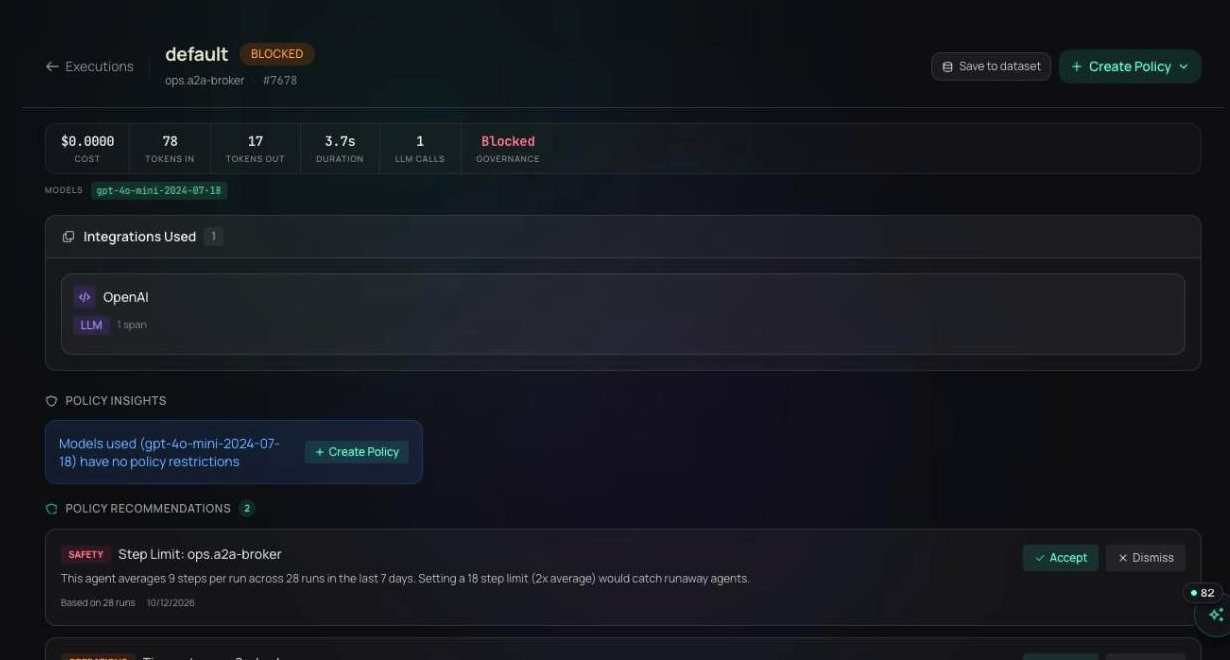
- 02Prove
The test record is the review.
Every test run writes a report: each scenario, what was expected, what happened, and a link to the trace. With a profile set, results upload to the workspace beside the runs they exercised. The reviewer reads a pass list. When the agent behaves, wax push ships the new version.
markdown report per run · trace links · results uploaded with -p · wax push
govern · policies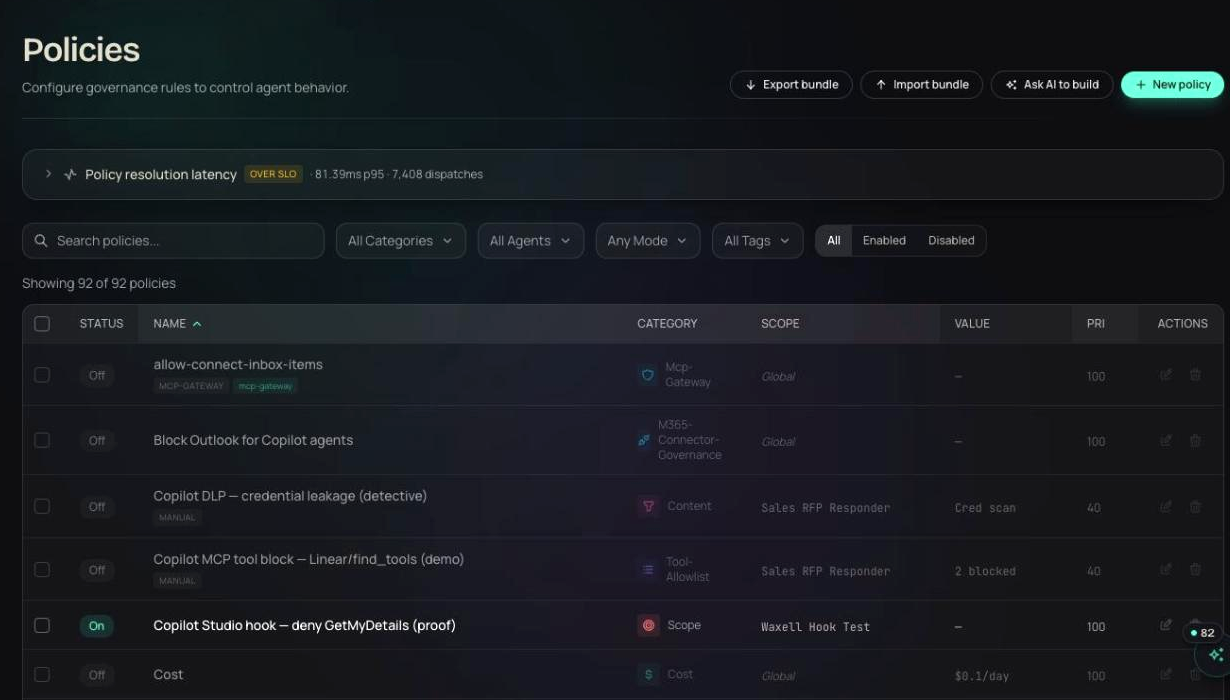

- s3.put · customers.csv to public buckettest · export-customers · expected no call · policy stopped it · passedblock
- email.send · finance@test · nightly-report · expected one call · passedallow
- stripe.refund · $4,000test · refund-over-limit · expected no refund before approval · passedhold
- s3.put · customers.csv to public buckettest · prompt v14 · export-customers · expected no call · test failed · exit code 1allow
Illustrative entries in the shape the product writes them.
Products in this play
What the agent did. A scenario names the tools that must and must not be called, the arguments they may carry, what the reply must and must not contain, and what should have changed in your systems. With policies on, an action the policy stopped is a call that never happened, so the scenario passes; if a prompt change gets it through, the build fails.
Run this play this week.
Free for your first agents and devices, live in about thirty seconds. Or walk through it with someone who has run it before.
30 minutes. No commitment.
SOC 2 Type II attested · ISO/IEC 27001:2022 certified · HIPAA with a BAA · aligned to the EU AI Act and NIST AI RMF