
NOW IN EARLY ACCESS

Your team has the tools.

Now make them work together.

Stop being the integration layer.

Waxell Connect links the AI tools you're already using — Claude, Cursor, OpenAI, and more — so they share context, hand off work, and move as one.

Free during beta. No setup changes to your existing tools.

SOC 2 Ready

Works With:

  • +More

NOW IN EARLY ACCESS

Governed execution for high-risk agent workflows.

Governed execution for high-risk agent workflows.

Waxell Runtime is the execution environment for AI agents that can't afford to be wrong — financial automation, healthcare workflows, infrastructure operations. Governance isn't added on top. It's native to every step.

Free during beta. No setup changes to your existing tools.

SOC 2 Ready

Works With:

+More

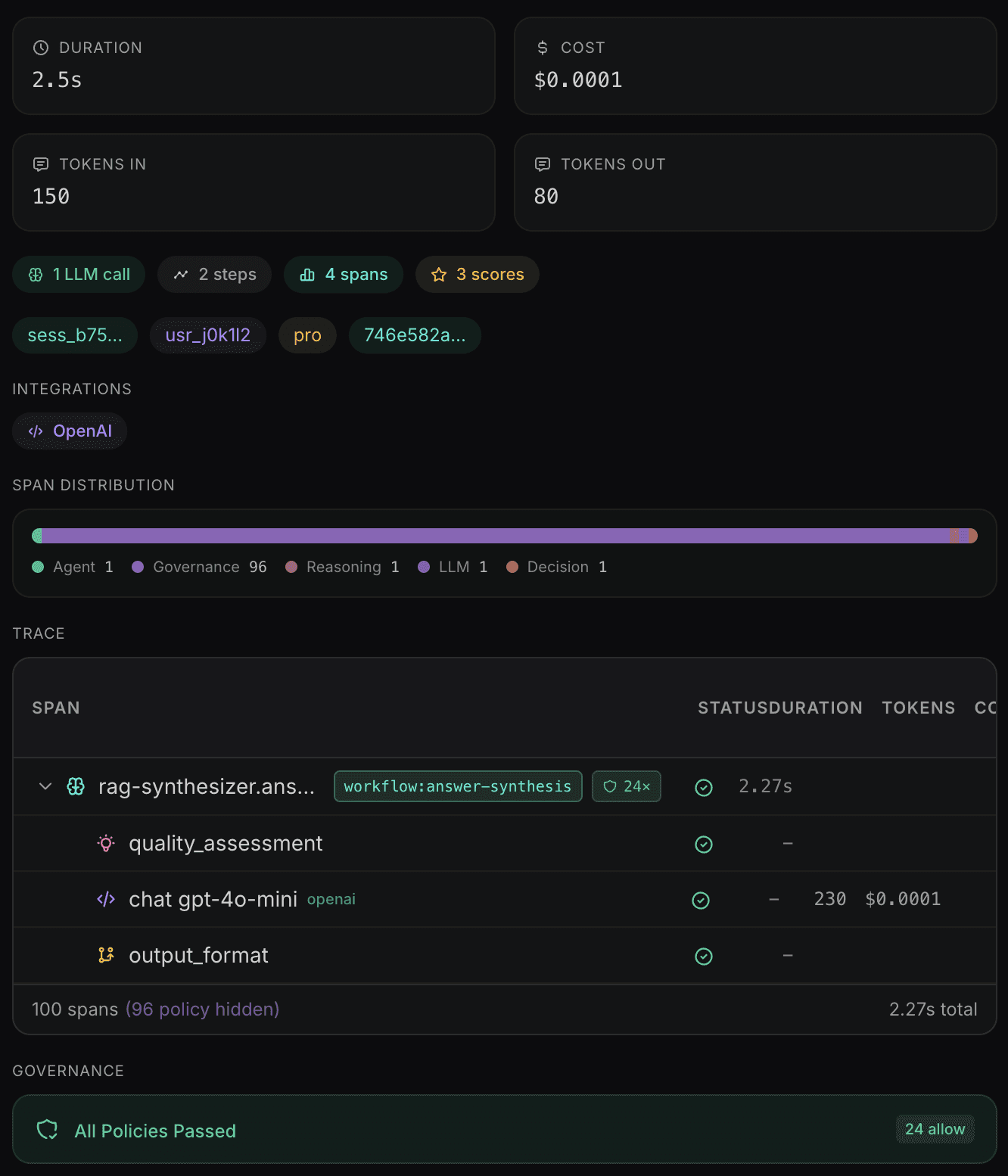
Waxell Observe dashboard showing a completed agent run: duration 638.8 seconds, LLM cost $0.6079, 108,041 tokens used, 6 steps completed. Left panel shows execution steps including accounts_selected, search_completed, validation_completed, and gap_fill_completed. Right panel shows an Execution DAG with 5 nodes — a list_building_agent workflow branching into search_contacts_tool, validate_contacts_tool, fill_gaps_tool, and a second validate_contacts_tool.

NOW IN EARLY ACCESS

Your team has the tools.

Now make them work together.

Stop being the integration layer.

Waxell Connect links the AI tools you're already using — Claude, Cursor, OpenAI, and more — so they share context, hand off work, and move as one.

Free during beta. No setup changes to your existing tools.

SOC 2 Ready

Works With:

+More

Observe governs the agents you have. Runtime governs the agents you're building.

Waxell Observe and Connect layer governance onto agents you've already built. That's the right approach for most workloads. Runtime is different.

When you build inside Runtime, the execution environment is the governance layer. Policies aren't evaluated after the agent acts — they gate what the agent is allowed to do before each step runs. There is no gap between execution and enforcement. For most workflows, governance-on-top is enough. For financial transactions, clinical documentation, and infrastructure automation, it isn't.

THE PROBLEM

You're using five tools.

You're still doing all the coordination.

You switch between AI tools all day to get things done — one for writing, one for code, one for research. But nothing connects them. You're the integration layer.

Copy-pasting outputs from one tool into the next

Re-explaining the same project background to every new session

Losing track of what each agent finished, what's still pending

Your human team and your AI tools living in completely separate worlds

What Runtime delivers

When AI tools don't share context, every human on the team becomes a router. You're the one forwarding outputs, re-briefing agents, and keeping track of where things stand.


Connect replaces that with a shared layer that all your tools — and your team — read and write from automatically. The coordination happens. You just don't have to do it.

Isolated execution

Every agent run executes in an isolated environment — no shared state, no cross-contamination between workflows or tenants. The agent runs inside Runtime's execution model, not inside your application process.

Policy enforcement before the first step

The same 25+ policy categories available in Observe — cost, safety, PII, compliance, identity, rate limits — are enforced natively in Runtime. Policies gate each step before it executes. Enforcement isn't a layer you add. It's how the environment works.


Kill switches at every level

Stop any agent, any workflow, any session — immediately. At the agent level, the workflow level, and the session level. No graceful shutdown. No waiting.


Durable workflows

Workflows checkpoint automatically at every step. A network failure doesn't lose the run. A policy trigger that requires human input pauses execution and waits — then resumes from the exact point it stopped, not from the beginning. Agents survive infrastructure restarts, model timeouts, and anything else production throws at them.

A dashboard after the fact is not governance. It's an autopsy.

Observability tools record what agents did. Waxell Observe captures that — and enforces policy during execution. Runtime goes further: it is the execution. There's no separation between running the agent and governing it.


Where LangSmith and Langfuse give you traces and dashboards, Waxell Observe adds enforcement. Runtime eliminates the distinction entirely — governance is the execution model, not a check that runs alongside it.

Two decorators. Full governance.

No instrumentation step. No wrapper classes. Define your agent with Waxell's SDK decorators — Runtime handles isolation, checkpointing, audit trails, and policy enforcement from the first run.

from waxell_sdk import agent, workflow, decision

@agent(name="financial-reconciliation")
class ReconciliationAgent:
    @workflow
    def run(self, ctx):
        result = ctx.call(self.validate)
        return ctx.call(self.execute, result)

    @decision
    def validate(self, ctx):
        return ctx.llm.classify(
            ctx.input.transaction,
            categories=["approved", "flagged", "requires-review"]
        )

Every @decision is logged, policy-evaluated, and audit-trailed automatically. Every @workflow is durable and resumable. Nothing else required.

HOW IT WORKS

Set once.
Your tools do the rest.

step 01

Add the tools your team already uses.

Add Claude Code, Cowork, Cursor, OpenAI — or any supported agent — to Connect. Each one joins a shared coordination layer without changing how it works on its own.

step 02

One workspace. Every tool reads from it.

Create workspaces for your projects and workflows. Drop in your files, notes, and working instructions. Every agent you connect will read from the same source — no more re-explaining background every session.

step 03

Work routes itself. You step in when it matters.

When one tool finishes a task, Connect routes it to the right next agent automatically. Progress is visible to your whole team — human and AI. You only get pulled in when a decision actually needs you.

Tired of governance being a Q3 item?

Tired of governance being a Q3 item?

Runtime ships 25+ policy categories. You ship the agent.

Runtime ships 25+ policy categories. You ship the agent.

Built for workflows where wrong is expensive.

Set once.
Your tools do the rest.

Financial automation

Wire transfers, reconciliation, fraud review. One unaudited execution isn't a log entry — it's a compliance finding. Runtime provides the audit trail and execution controls that SOX, MiFID II, and SR 11-7 require, natively, before your agent takes its first step.

Healthcare workflows

Clinical documentation, medical coding, care coordination. HIPAA requires a chain of custody for every AI decision touching PHI. Runtime provides it from the first run — no post-hoc logging patched on after the fact.


Infrastructure operations

Deployment pipelines, incident response, cloud resource management. High-consequence, low-tolerance-for-error. Human-in-the-loop approvals are built into the workflow — not bolted on as a notification you might miss.


Worried about rewriting your existing agents?

Runtime is the right choice for new builds and planned migrations — not forced rewrites. If you have agents running today, Waxell Observe gives you full governance with two lines of code and no changes to your existing logic.


Runtime is where you land when the stakes require it.

Progressive migration

Start with Observe, move to Runtime for the workflows that need it. Every step delivers standalone value. No commitment required until you're ready.

What does Runtime support?

HIPAA, SOC 2, and PCI-DSS compliance profiles out of the box. Data residency in US or EU. The same policy dashboard, the same audit trail, the same team as Observe.

Compliance profiles

HIPAA · SOC 2 · PCI-DSS

Runtime

Python — sync and async

Data residency

US East · EU West

Policy categories

25+ — same engine as Observe

Agents that run in production need more than a dashboard.

They need an execution environment that's governed from the first step.

Free TO START. No setup changes to your existing tools.

SOC 2 Ready

Stop being the integration layer.

Connect your AI stack, give it shared context, and get back to the work that actually needs you.

Free TO START. No setup changes to your existing tools.

SOC 2 Ready

FAQ

What is Waxell Runtime?

Waxell Runtime is a governed execution environment for AI agents built with the Waxell SDK. Unlike observability tools that layer governance onto existing agents, Runtime treats governance as a first-class part of execution — every workflow step is policy-gated, every decision is auditable, and every run is isolated by default.

How is Runtime different from Waxell Observe?

Observe instruments agents you've already built — it captures what they're doing and enforces policies during execution. Runtime is the environment you build inside: governance is native to every step, with no instrumentation step and no gap between execution and enforcement.

What kinds of workflows is Runtime designed for?

High-risk, high-consequence automation: financial transactions, healthcare workflows, infrastructure operations. Runtime is the right choice when a single unaudited execution carries compliance, financial, or patient safety consequences.

How do durable workflows work in Runtime?

Runtime checkpoints workflow state at each step. If a step fails, the workflow resumes from the checkpoint — not from the beginning. Human-in-the-loop decisions pause execution until approved or rejected, then resume automatically.

Does Runtime work with LangChain or other frameworks?

Runtime uses the Waxell SDK — agents are built with Waxell's Python decorators rather than another framework's primitives. If you have existing LangChain, CrewAI, or custom agents, start with Observe. Runtime is the path for new builds or planned migrations.

What compliance profiles does Runtime include?

Runtime's policy engine includes HIPAA, SOC 2, and PCI-DSS compliance profiles out of the box. Enterprise tenants can configure data residency in US East or EU West at onboarding.

How does Runtime relate to Observe and Connect?

Three products, one governance platform. Connect governs agents you didn't build — no code changes required. Observe instruments agents you've built — two lines of Python. Runtime is what you build inside when the stakes require governance to be native to execution, not layered on top of it.

Waxell

Waxell provides observability and governance for AI agents in production. Bring your own framework.

© 2026 Waxell. All rights reserved.

Patent Pending.

Waxell

Waxell provides observability and governance for AI agents in production. Bring your own framework.

© 2026 Waxell. All rights reserved.

Patent Pending.

Waxell

Waxell provides observability and governance for AI agents in production. Bring your own framework.

© 2026 Waxell. All rights reserved.

Patent Pending.