REGISTRY
You built the agents.
Do you know what they're actually running?
The hardest problem in production AI isn't generating outputs. It's knowing whether what's executing matches what you think is executing. The Waxell Registry makes that answer explicit — derived from live code, not design intent.
Define what your agents are allowed to do — and enforce it everywhere, instantly.
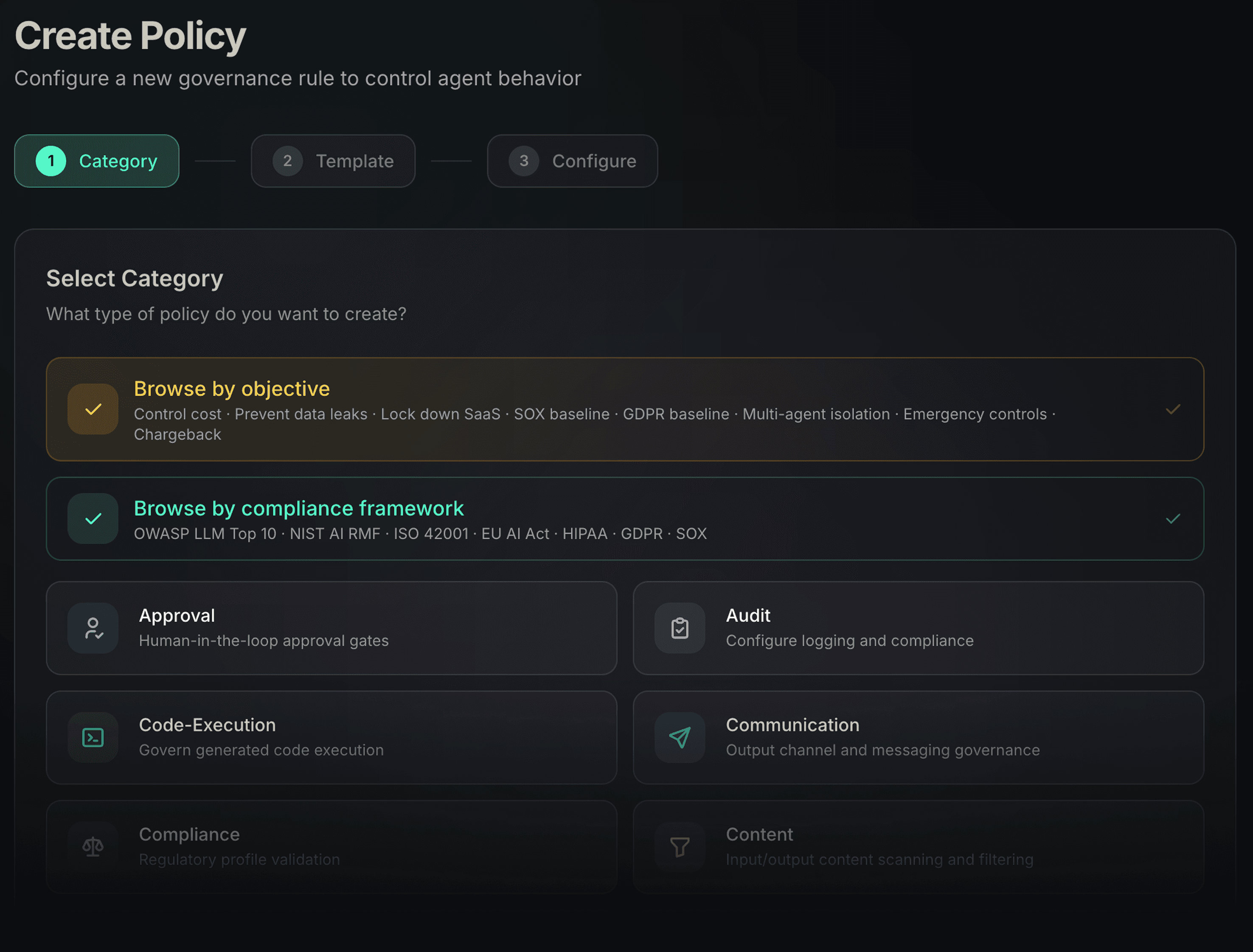
Waxell Policies are runtime enforcement rules for AI agents — defined once in the governance plane, applied uniformly across every workflow, and evaluated deterministically before execution proceeds. When a policy changes, it changes everywhere. No code deploy required.
Free to start. 2-line setup.

SOC 2 compliant
Define what your agents are allowed to do — and enforce it everywhere, instantly.
Waxell Policies are runtime enforcement rules for AI agents — defined once in the governance plane, applied uniformly across every workflow, and evaluated deterministically before execution proceeds. When a policy changes, it changes everywhere. No code deploy required.
Free to start. 2-line setup.
SOC 2 compliant
THE PROBLEM
As agentic systems grow, design intent and execution reality diverge. New tools get added between reviews. Workflows get modified without a registry update. In MCP environments, a tool update made by a third party can change agent behavior overnight — without a deploy, without a code review, and without anyone noticing until something goes wrong.
THE PROBLEM
As agentic systems grow, design intent and execution reality diverge. New tools get added between reviews. Workflows get modified without a registry update. In MCP environments, a tool update made by a third party can change agent behavior overnight — without a deploy, without a code review, and without anyone noticing until something goes wrong.
What Waxell Registry Is
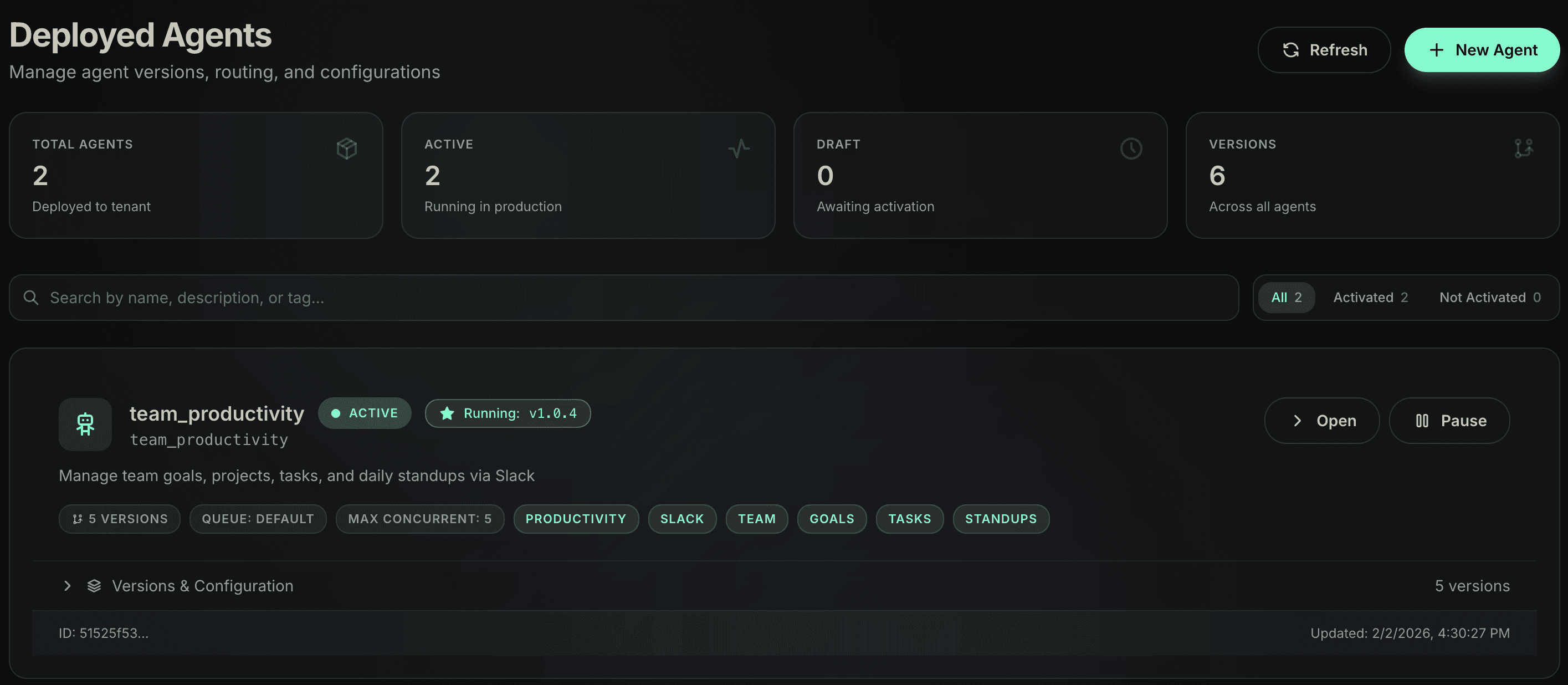
The Registry is Waxell's system of record for every agent, workflow, and tool permitted to run. Every component has an identity. Every call traces back to a known definition. Policy enforcement, observability, and audit all operate against registered definitions — which means drift surfaces before production, not after.
How It Works
How It Works
CODE REALITY DAG
Not a diagram you draw — derived directly from live code. For every registered workflow, Waxell generates a structural map of actual execution, updated automatically. No diagrams to maintain.
ENFORCED HIERARCHY
Agents own execution. Workflows define structure. Tools are the atomic operations where data changes. This isn't a convention — it's enforced. Components that don't fit the structure can't participate in governed execution.
MCP TOOL GOVERNANCE
Only registered tools can be called. Unregistered tools can't participate in execution — structurally, not by rule. The set of callable tools is always bounded, versioned, and auditable.
Three Differentiators
CHANGES TAKE EFFECT IMMEDIATELY
Policies aren't embedded in agent code — they live in the governance plane and are applied by reference. Adjust a rule and it propagates across every workflow that references it, instantly. No redeployment. No drift.
MANAGED BY NON-ENGINEERS
Policy ownership belongs to the people responsible for governance, compliance, and operations — not the engineers who wrote the workflows. Because policy logic is separate from agent code, adjusting a rule doesn't require touching the system it governs.
DETERMINISTIC BY DESIGN
When a policy condition isn't met, execution stops. No probabilistic reasoning, no adaptive override, no silent exception. The outcome is explicit and logged — which policy applied, what condition failed, and the surrounding context — before you ever need to look.
How to Get Started
01
Install and initialize
pip install waxell-observe
and initialize before your imports. Waxell is framework-agnostic — works with LangChain, CrewAI, LlamaIndex, and custom Python agents. No changes to existing agent logic required.
02
Registry is derived automatically
Waxell registers your agents, workflows, and tools from live code. The Code Reality DAG is generated automatically and stays current. No diagrams to draw or maintain.
03
Enforcement and observability begin
Policy enforcement, observability, and audit records all operate against the registered definitions. Drift surfaces before production. Every execution traces back to a known, versioned component.
01
Install and initialize
pip install waxell-observe
and initialize before your imports. Waxell is framework-agnostic — works with LangChain, CrewAI, LlamaIndex, and custom Python agents. No changes to existing agent logic required.
02
Registry is derived automatically
Waxell registers your agents, workflows, and tools from live code. The Code Reality DAG is generated automatically and stays current. No diagrams to draw or maintain.
03
Enforcement and observability begin
Policy enforcement, observability, and audit records all operate against the registered definitions. Drift surfaces before production. Every execution traces back to a known, versioned component.
Code Reality DAG
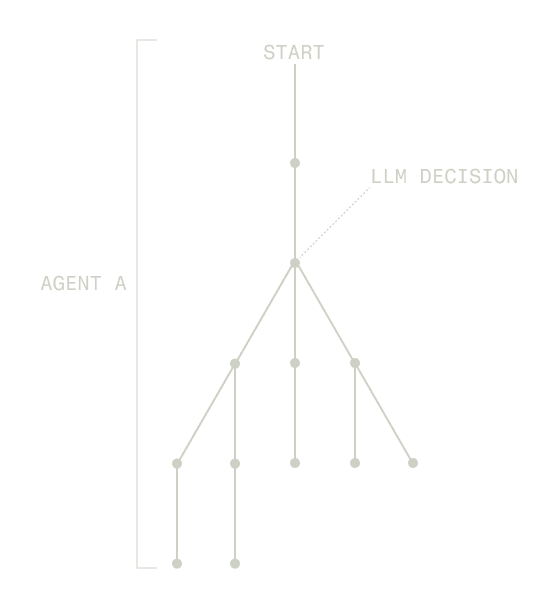
For every registered workflow, Waxell derives a Code Reality DAG — a structural representation of execution derived directly from live code.
This is not a diagram you draw. It is not a modeled plan or a design-time artifact. The Code Reality DAG reflects the execution structure as it exists in the system right now — not as it was intended to exist when the workflow was written.
Most teams operate agent systems based on design intent. They know how a workflow is supposed to behave and which tools it is supposed to use. The Code Reality DAG makes it possible to verify that. Expected structure and observed structure can be compared directly. Drift becomes visible instead of silent — and visible before it causes production failures, not after.
MCP & Tool Access
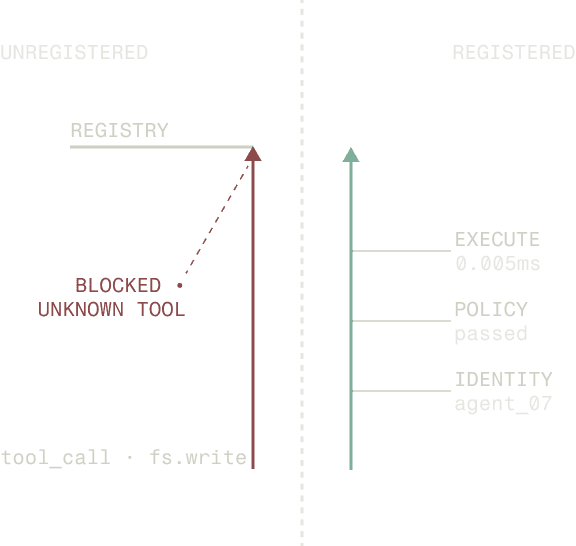
In an ungoverned system, agents can call any tool they discover — including tools added or modified after the agent was deployed. In MCP environments, that's the rug pull: a tool update you didn't make, can't see, and won't notice until it changes agent behavior in production.
The Registry closes that surface. Only registered tools can be called. Every tool has an identity. Every call traces back to a known, versioned definition. Unregistered tools cannot participate in execution. The boundary is structural — it doesn't depend on rules being written correctly or policies being applied in the right order.
For teams using MCP-connected agents, the Registry is how you know the callable tool surface stays bounded as the system evolves.
How to Get Started
01
Install and initialize
pip install waxell-observe
and initialize before your imports. Waxell is framework-agnostic — works with LangChain, CrewAI, LlamaIndex, and custom Python agents. No changes to existing agent logic required.
02
Registry is derived automatically
Waxell registers your agents, workflows, and tools from live code. The Code Reality DAG is generated automatically and stays current. No diagrams to draw or maintain.
Waxell registers your agents, workflows, and tools from live code. The Code Reality DAG is generated automatically and stays current. No diagrams to draw or maintain.
03
Enforcement and observability begin
Policy enforcement, observability, and audit records all operate against the registered definitions. Drift surfaces before production. Every execution traces back to a known, versioned component.
Set once.
Your tools do the rest.
01
Install and initialize
pip install waxell-observe
and initialize before your imports. Waxell is framework-agnostic — works with LangChain, CrewAI, LlamaIndex, and custom Python agents. No changes to existing agent logic required.
02
Registry is derived automatically
Waxell registers your agents, workflows, and tools from live code. The Code Reality DAG is generated automatically and stays current. No diagrams to draw or maintain.
03
Enforcement and observability begin
Policy enforcement, observability, and audit records all operate against the registered definitions. Drift surfaces before production. Every execution traces back to a known, versioned component.
POLICY A
POLICY B
POLICY C
POLICY D
Designed to scale
Centralized, reference-based policies scale cleanly across workflows, teams, and environments.
They are suitable for systems where execution is continuous, changes are expected, and governance must remain consistent over time.
Policies do not become harder to manage as automation expands. They become more important.
CallSine automatically finds and researches each prospect by analyzing their website, LinkedIn profile, and company information. Get comprehensive insights instantly without spending hours on manual research. It even works with your existing database.
From here
Waxell is available now.
Install the SDK, connect to your instance, and start capturing what your agents actually do. Governance, policy enforcement, cost tracking, and full telemetry — running from the moment you initialize.
Free during beta. 2-line setup.
FAQ
What is AI agent policy enforcement?
AI agent policy enforcement is the practice of applying predefined governance rules to autonomous agents at runtime — before or during execution — to ensure they operate within defined boundaries. Unlike observability, which records what agents did, enforcement prevents disallowed actions from completing. Waxell enforces policies deterministically across 26 categories, including cost limits, content filtering, kill switches, and PII protection.
How does Waxell enforce policies before execution begins?
When a workflow is triggered, Waxell evaluates all applicable policies against the current context before execution proceeds. Policies are stored centrally in the governance plane — not embedded in agent code — and applied by reference. If a policy condition is not met, execution stops and the outcome is logged with full context. There is no probabilistic reasoning, adaptive override, or silent exception.
What types of AI agent policies can Waxell enforce?
Waxell supports 26 policy categories covering the full surface area of agent behavior: cost and token limits, content and input scanning, PII protection, kill switches, rate limits, scheduling constraints, identity controls, data access restrictions, LLM-specific rules, human approval gates, and more. For teams with compliance requirements, Waxell Assurance covers how these policies map to audit, accountability, and operational trust.
Can Waxell policies be applied to existing agents without code changes?
Yes. Waxell instruments existing Python agents in two lines of code — install the SDK, initialize before your imports, and policy enforcement begins automatically. Waxell is framework-agnostic and works with LangChain, CrewAI, LlamaIndex, and custom Python agents. No changes to existing agent logic are required.
What happens when a Waxell policy blocks an agent execution?
When a policy condition is not met, execution halts and the event is recorded with full context — which policy applied, what condition failed, and the surrounding execution state. The record exists immediately and is inspectable without reconstructing from logs. Policy owners can review blocked executions, adjust rules, and retest using the same inputs and constraints that triggered the block.
From here
Waxell is available now.
Install the SDK, connect to your instance, and start capturing what your agents actually do. Governance, policy enforcement, cost tracking, and full telemetry — running from the moment you initialize.
Free during beta. 2-line setup.

FAQ
What is the Waxell Code Reality DAG?
The Code Reality DAG is a structural representation of a workflow derived directly from live code — not a drawn diagram or a design-time artifact. It reflects the actual execution structure of a workflow as it currently exists in the system, updated automatically. Teams use it to compare expected execution structure against actual execution structure, making drift visible before it causes failures in production.
How does Waxell's Registry support MCP tool governance?
In a system using Model Context Protocol, agents access external tools at runtime. Without a registry, the set of callable tools is implicit and unauditable — and tool changes made upstream can silently change agent behavior. Waxell's Registry requires every tool, including MCP tools, to be registered and identified before it can be called. The callable tool surface is always bounded, every call is traceable to a known definition, and changes to tool access are explicit and versioned.
Can existing agents be registered in Waxell without being rebuilt?
Yes. Waxell instruments existing Python agents in two lines of code — install the SDK, initialize before your imports, and agents are registered and governed automatically. Waxell is framework-agnostic and works with LangChain, CrewAI, LlamaIndex, and custom Python agents. No changes to existing agent logic are required.

Waxell
Waxell provides observability and governance for AI agents in production. Bring your own framework.
Compliance: NIST AI RMF · EU AI Act · SOC 2 compliant · ISO/IEC 27001:2022 certified · HIPAA (in progress)
Governed continuously in Vanta.
© 2026 Waxell. All rights reserved.
Patent Pending.
Waxell
Waxell provides observability and governance for AI agents in production. Bring your own framework.
Compliance: NIST AI RMF · EU AI Act · SOC 2 compliant · ISO/IEC 27001:2022 certified · HIPAA (in progress)
Governed continuously in Vanta.
© 2026 Waxell. All rights reserved.
Patent Pending.
Waxell
Waxell provides observability and governance for AI agents in production. Bring your own framework.
Compliance: NIST AI RMF · EU AI Act · SOC 2 compliant · ISO/IEC 27001:2022 certified · HIPAA (in progress)
Governed continuously in Vanta.
© 2026 Waxell. All rights reserved.
Patent Pending.