
BUDGETS
One looping agent can generate a $40,000 bill before anyone notices. Waxell Budgets stops execution before the limit is crossed — not after the invoice arrives. No retry logic. No adaptive workarounds. No surprises.
A runtime enforcement layer for AI agent cost control. Budget limits are defined in the governance plane — per agent, per model, per time period, across the system — and evaluated before execution begins. When a limit is reached, execution stops cleanly and the event is recorded.
Budget limits live outside agent code. Changes take effect immediately without a deploy.
ENFORCED BEFORE EXECUTION
Limits are checked before work begins, not after the bill arrives. When an agent would exceed a configured limit, execution stops deterministically — no silent degradation, no retry.
MANAGED WITHOUT CODE CHANGES
Budgets are owned by non-engineer operational owners. Tighten or relax limits in response to real usage — no deploy, no access to agent internals required.
VISIBLE IN WAXELL OBSERVE
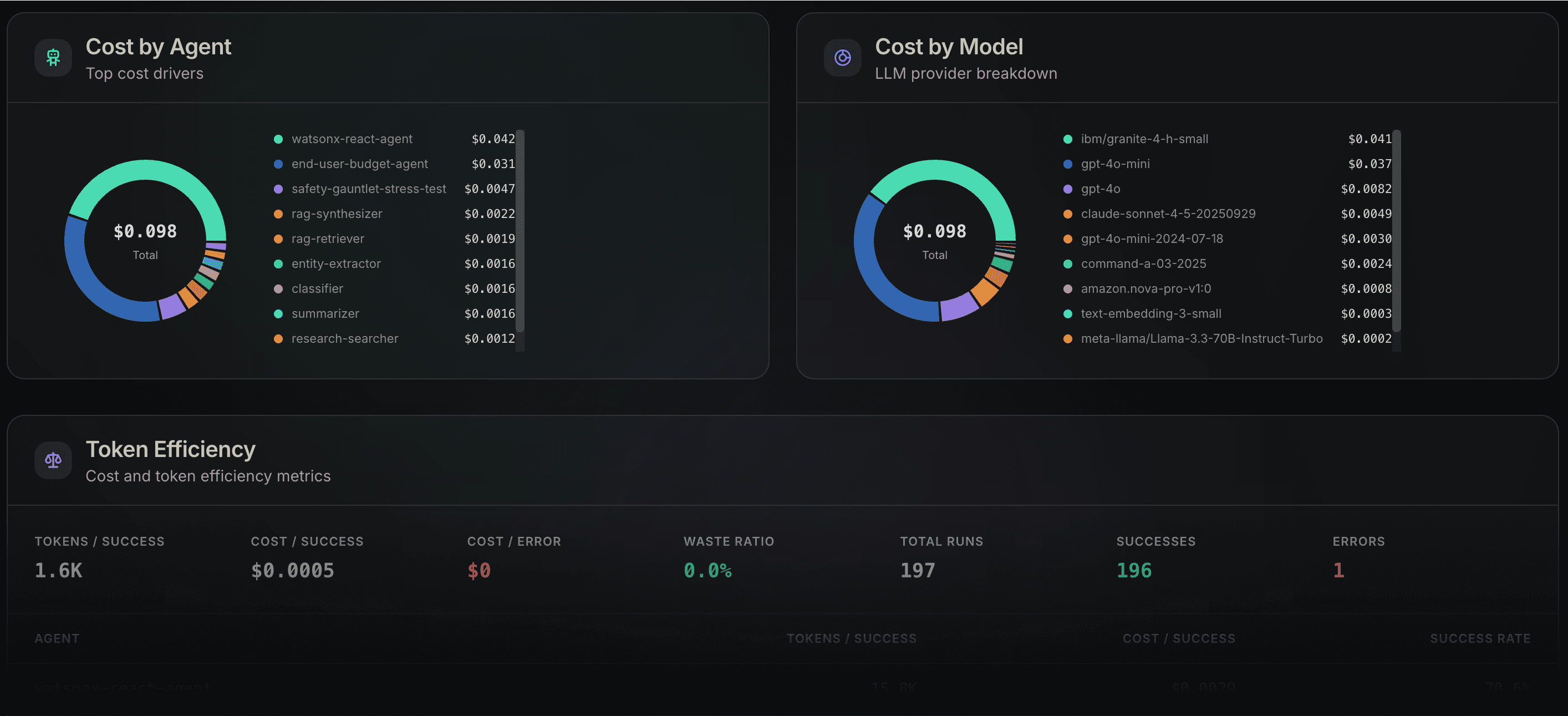
Budget usage and enforcement events are broken down by agent, by model, and over time — on the same observability layer as traces, executions, and telemetry.

What Waxell Tracks
Per-agent spend ceilings. Per-model token caps. System-wide cost bounds by time period. Every enforcement event is logged with full context — which agent, which model, what limit was reached, and when. The record exists before it's needed.
How it Works
01
Define limits in the governance plane.
Set token or spend limits per agent, per model, or system-wide. No changes to agent code — budgets are applied by reference at runtime.
02
Execution is evaluated before it begins.
When an agent triggers a run, Waxell checks the applicable budget limits against the governance plane. If the limit is met, execution stops cleanly. If within bounds, work proceeds normally.
03
Every enforcement event is recorded.
Budget hits are logged in Waxell's cost analytics with full context. No reconstruction from logs needed.

FAQ
Why does cost governance matter for production AI agents?
Agent-based workflows consume resources incrementally and often asynchronously. Without explicit limits, usage accumulates quietly — a billing surprise, a runaway process, or a usage anomaly that's already happened by the time it's visible. Waxell Budgets sets enforced limits in advance so budget boundaries hold regardless of how agents are instructed or how workloads scale.
Can Waxell Budget limits be changed without modifying agent code?
Yes. Budgets are defined in Waxell's governance plane, separate from agent logic. Because limits are applied by reference at runtime, they can be adjusted — tightened, relaxed, or reassigned — without code changes, without redeployment, and without requiring the team managing limits to understand agent internals.
What happens when an AI agent hits a Waxell Budget limit?
Execution stops in a predictable, recordable way. The enforcement event is logged in Waxell's cost analytics with full context — which agent, which model, what limit was reached, and when. No post-hoc investigation needed.